Squirrel Hunters, Clear-Cuts and Sweeping Transformation of U.S. Forest Policies
Why the Izaak Walton League v. Butz Matters
Outdoor America 2026, Issue 3
Author: Char Miller
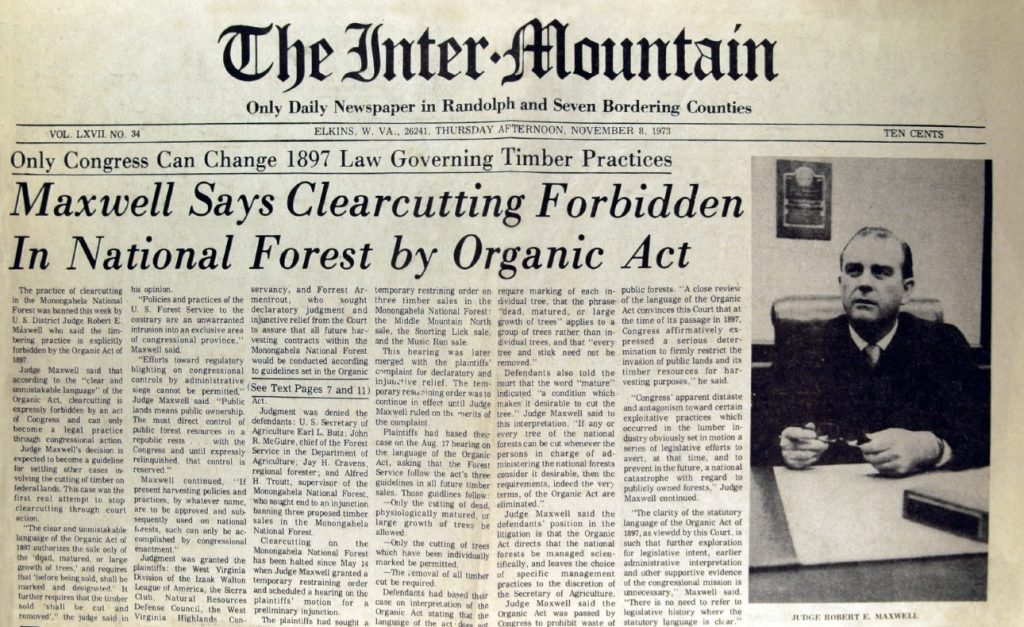
The banner headline on the front page of the Elkins, West Virginia, newspaper for November 8, 1973, could not have been more direct or revelatory: “Maxwell Says Clearcutting Forbidden in National Forest by Organic Act.”1 Only a few months before, federal judge Robert Maxwell, a former prosecutor in Elkins whom President Lyndon Johnson had elevated to the U.S. District Court for the Northern District of the state, had heard arguments in West Virginia Div. of Izaak Walton League v. Butz (367 F. Supp. 42).
His decision sent shock waves through Region 9 of the U.S. Forest Service, which encompassed national forests from Minnesota to Pennsylvania and Maine, as well as through the entire national forest system. More than 50 years later, the Monongahela Controversy reverberates still. It is worth revisiting why the original lawsuit was brought, for in many respects it was the single most important event in the history of the Monongahela National Forest and of the agency that manages it.
At the time of the lawsuit, 784,000 of Monongahela’s 820,000 acres were classified as commercial forest land. The Izaak Walton League’s case, however, focused on three proposed timber sales that covered a mere 1,077 acres—the 428 of which were to be clear-cut, the plaintiffs argued, were in violation of the Organic Act of 1897. The act—the foundation upon which 75 years of federal forest policy had depended—had identified the objectives by which the national reserves (now national forests) would be managed: “to improve and protect the forest within the boundaries, or for the purpose of securing favorable conditions of waterflows, and to furnish a continuous supply of timber for the use and necessities of citizens of the United States.”2
Although the Monongahela National Forest was not formally established until April 28, 1920, the Arnold family of Elkins, in Tucker County, offered 7,200 acres, known “Purchase Case No. 1” to the federal government in August 1911; the deed of sale was formally signed four years later, in late November 1915. This and subsequent purchases were conducted under the auspices of the Weeks Act (1911), which allowed the government to purchase land from willing sellers in upland watersheds in the eastern half of the United States; by the 1920s, Weeks Act dollars had had expanded the Monongahela to 150,327 acres.
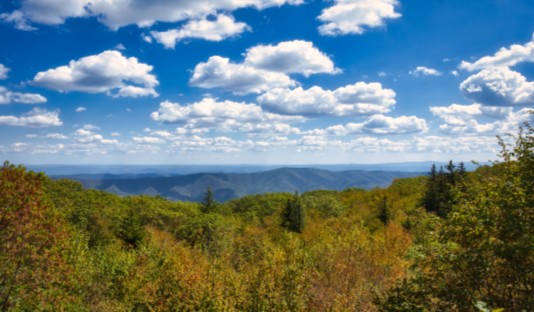
The management goal in West Virginia and elsewhere, wrote W. W. Ashe, who as secretary of the National Forest Reservation Commission oversaw Weeks Act purchases, was to restore the “dreary waste as has been the fate of much of the fir- and spruce-clad slopes” in the Allegheny Mountains.3 Today, the Monongahela protects 921,000 acres and continues to sustain local and regional watersheds, most notably the headwaters of the Potomac River, the main source of drinking water for Washington, DC, home to the Forest Service’s national headquarters.4
But it was not potable water that was the paramount issue in 1973; it was timber. Those arguing against clear-cutting pointed out that the Organic Act only allowed the harvest of “dead, physically mature and large growth trees individually marked for cutting.” Judge Maxwell concluded that the agency’s clear-cutting practices violated this provision of the original legislation, and because that act was an act of Congress, it could only be altered through congressional legislation. “Policies and practices of the U.S. Forest Service to the contrary are an unwarranted intrusion into an exclusive area of congressional province.” Two years later, the US Fourth Circuit Court of Appeals would uphold Judge Maxwell’s decision.5
Challenging the Forst Service get-out-the-cut campaign
The Monongahela Controversy was linked to an array of legal challenges to the Forest Service’s postwar get-out-the-cut campaign, a pattern of accelerated harvesting designed to bring large quantities of wood to market in response to the nation’s construction boom.
Backed by scientific research indicating that even-aged management of forests (that is, clear-cutting) would produce a better quality and higher volume of timber, the agency managed large-acreage sales using this practice on its forests uniformly across the country. Wielding more powerful chainsaws and firing up military surplus bulldozers to build roads deep into the backcountry, loggers on the Monongahela and elsewhere removed billions of board feet every year.
In 1945, loggers cut approximately two billion board feet (2 BBF) on the national forests, in 1960 the total was 9.3 BBF and by the mid-1980s the figure had soared to 18 BBF. Even one of its advocates recognized that clear-cutting left behind “an aura of total devastation.”6
Squirrel and turkey hunters in West Virgina blow the whistle
Among the first to blow the whistle was a clutch of squirrel and turkey hunters in West Virginia. They were infuriated that intense logging had rendered unusable their traditional hunting grounds on the Monongahela, their commons and the public nature on which they depended.
They were angered that the Forest Service effectively handed over this communal, multi-use resource to single-use timber companies. And they were worried that the federal agency, which had done so much to restore what in the early twentieth century had been a badly burned and cutover landscape on the Allegheny Front Range, was destroying these now healthy, resilient forests.
To seek redress, they first lobbied the West Virginia legislature, and during the 1960s the state body responded with a series of hearings and resolutions to rein in the Forest Service’s actions.
The agency cavalierly ignored these cautions, not least because the Monongahela was under federal, not state, management. Agency foresters in West Virginia also took their cue from their chief, Edward Cliff, who met with and subsequently dismissed the pleadings of a delegation of West Virginia hunters, conservationists and politicians. “I recognized their viewpoint and sympathized with it,” he later recalled about the meeting. “But my initial reaction was—what’s more important, the personal pleasure of a small handful of people for turkey hunting, or the utilization of this resource for production of jobs and raw material, done under a silvicultural system that, if properly applied, was sound? Personally, I didn’t pay as much attention to that protest as perhaps it deserved. I didn’t recognize the strength of the opposition that could be developed over this issue. What I didn’t realize is how potent they could be in expanding this protest. and their capacity to galvanize public opinion but seemed to never forgive them either.”7
League’s lawsuit catches the Forest Service off-guard
Rebuffed, the West Virginia Division of the Izaak Walton League of America, filed a lawsuit against the Forest Service. The League is a national conservation organization founded in 1922 that advocates for the protection of natural resources; among its early victories was the 1924 creation of the Upper Mississippi River National Wildlife and Fish Refuge.8
The lawsuit gained considerable public support throughout the Mountain State and the League also was joined by other conservation organizations, including the National Resources Defense Council and the San Francisco–based Sierra Club. This growing coalition ensured that the case would have national implications. Judge Maxwell’s decision in support of the legal challenge, and the appeal court’s sustaining of it, caught the Forest Service completely off-guard. It was the first time that its expertise had been adjudicated and found wanting.
Judge Maxwell’s decision technically only applied to lands in the Fourth Circuit, which encompassed Virginia and West Virginia, Maryland, North and South Carolina. But its decision effectively, if temporarily, shut down the agency’s timber sales program nationwide. Aware that this might be the result, and in acknowledgment that the Organic Act might be outdated, the court advised that the “the appropriate forum to resolve this complex and controversial issue was not the courts, but Congress.”9
Result: sweeping transformation in the nation’s forest policy
With that, the battle that had erupted on the Monongahela shifted to Capitol Hill, and two legislative initiatives were the result: the Resources Planning Act (1975) and the National Forest Management Act (1976). Together these laws, now 50 years old, required every national forest to produce a management plan, which would include an environmental impact statement that would consider and weigh ecological and hydrological—as well as social—values. In turn these documents must be vetted by the public; if their goals and actions were in dispute, they must be revised accordingly.
For the agency, which hitherto had determined when and how the national forests would be managed, these new laws signaled the beginning of a more collaborative, open and transparent process, though it would take the Forest Service several years—decades, even—to fully embrace that process.
The controversies did not stop, however. Instead, in West Virginia, as well as in New Hampshire, Texas, Kentucky, Puerto Rico and across the West, individual forest plans ever since have been challenged in public venues and federal courts.10 These long-running battles are one of the costs of a more democratic process, and from a certain perspective has created a sense of gridlock. Those who hold this position argue that such debates have been antithetical to sound management of the national forests and grasslands, both locally and systemwide.
But the Monongahela and other national forests are public lands and require public scrutiny to ensure that their management adheres to what the citizenry values. That requirement has always been so; indeed, it was a key element of the agency’s founding ethos. As affirmed in the Forest Service publication The Use of the National Forests (1907): “National Forests are made for and owned by the people. They should also be managed by the people.” Their active engagement was deliberately set up in opposition to those who, like Ed Cliff, appeared to believe otherwise. The national forests were not created “to give officers in charge of them a chance to work out their theories, but to give the people who use them, and those affected by their use, a chance to work out their own best profit.”11
The Izaak Walton League v. Butz decision compelled the Forest Service to acknowledge that its top-down management of the forests, which dovetailed with its faith in its expertise as well its command-and-control organizational structure, was as outdated as the 1897 Organic Act. From this moment, the agency slowly underwent a vital transformation.
The transformation resulted in large part because one day in 1964, hunters headed up into the Monongahela National Forest and came down ready to fight for this public land and their common rights in its bounty.12
1 Gillian Mace Berman and Melissa Conley-Spencer, Monongahela National Forest, 1915–1990 (West Virginia University Public History Program, 1992), 148; The Elkins Inter-Mountain, November 8, 1973, 1, https://www.fs.usda.gov/greatestgood/images/gallery/logging/photo8.jpg.
2 Quoted in West Virginia Div. of Izaak Walton League, Inc. v. Butz, 367 F. Supp. 422 (N.D.W. Va. 1973), https://law.justia.com/cases/federal/district-courts/FSupp/367/422/1425532/.
3 W. W. Ashe, “The Creation of the Eastern National Forests,” American Forests, September 1922, 523.
4 Christopher Johnson and David Govatski, Forests for the People: The Story of America’s Eastern National Forests (Island Press, 2013), 187–206.
5 The Elkins Inter-Mountain, November 8, 1973, 1.
6 Kathryn Newfont, Blue Ridge Commons: Environmental Activism and Forest History in Western North Carolina (University of North Carolina Press, 2012), 130–138.
7 Edward P. Cliff, Ronald B. Hartzer, and David A. Clary, Half a Century in Forest Conservation: A Biography and Oral History of Edward P. Cliff (USDA Forest Service, 1981); Newfont, Blue Ridge Commons, 135.
8 Stephen Fox, John Muir and His Legacy (Little, Brown, 1981), 159–172.
9 West Virginia Division of the Izaak Walton League of America, Inc. v. Butz, No. 74–1387 (4th Cir. August 21, 1975), http://elr.info/sites/default/files/litigation/5.20573.htm.
10 In West Virginia, for example, activists pursued initiatives to expand wilderness designations in the Monongahela National Forest, hoping to make it the regional hub of wildlands—a “wilderness corridor”—connecting the George Washington National Forest, and state parks in Pennsylvania and Maryland. R. F. Mueller, “Central Appalachian Wilderness in Perspective, Wild Earth 2, no. 3 (1992): 56–60, http://asecular.com/forests/vfw/monon.htm.
11 The Use of the National Forests (USDA Forest Service, 1907), 25–26.
Char Miller Biography
Char Miller is the W.M. Keck Professor of Environmental Analysis and History at Pomona College, Claremont, Calif. He has written extensively about the U.S. Forest Service, including the forthcoming Regenerating the Land: The People, Politics, and Policies that Created the Eastern National Forests (West Virginia University Press, 2027).
West Virginia Division helped shape U.S. Forestry policy
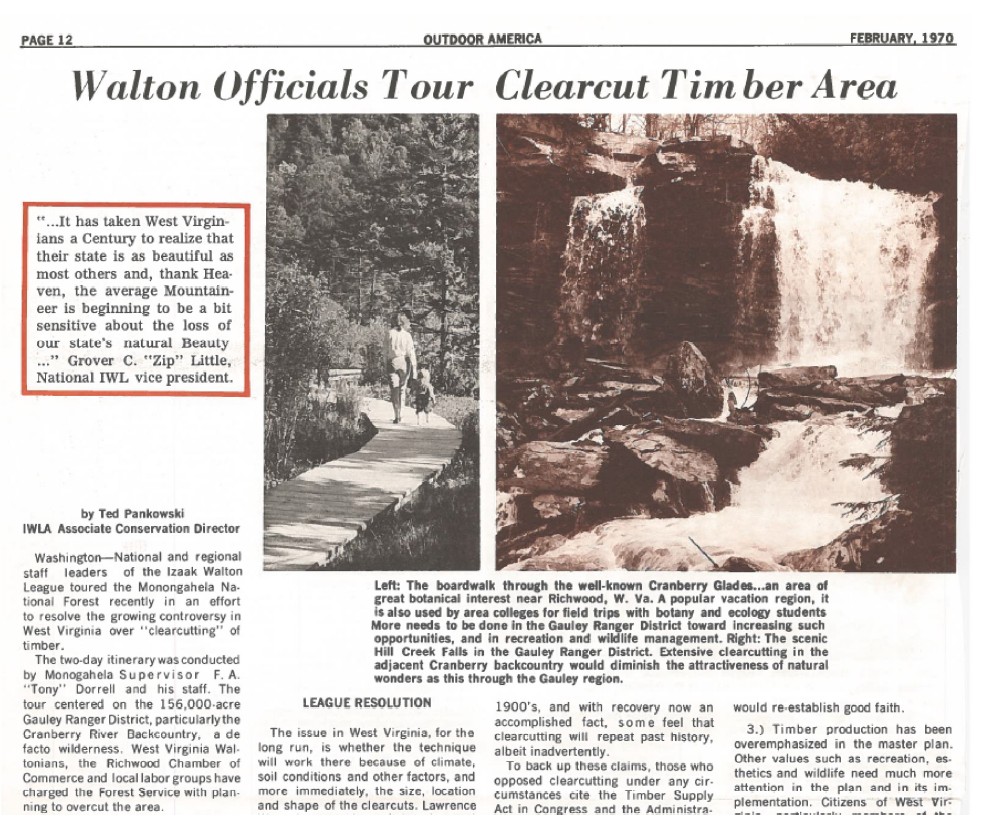
Concerned about extensive, indiscriminate clear cutting in the Monongahela National Forest in the 1960s, the West Virginia Division of the Izaak Walton League helped create the West Virginia Forest Management Commission to assess that problem. After analyzing forest management practices in the Monongahela, the Commission issued a report with 15 recommendations, which the League accepted.
However the Forest Service did not accept two of the key recommendations that advocated for selective rather than wholesale clear-cutting of timber.
The national office of the Izaak Walton League also issued recommendations. Leaders called for a multiple-use approach in national forests in recognition of forest use for recreation and wildlife habitat. The League called for greater public participation in forest management decisions and a moratorium on timber sales in one district “until public involvement and analysis of the proposed master plan takes place.”
These circumstance led to the West Virginia Division’s decision finally to sue the Forest Service in what would turn out to be a landmark, far-reaching case decided in November 1973, West Virginia Division of the Izaak Walton League v. Butz (Earl Butz was USDA secretary at the time).
The decision prompted Congress to address the need for forest planning and management in two separate laws, the Resources Planning Act (1975) and the National Forest Management Act (1976).

 Your kit will include a bottle containing 25 nitrate test strips which you can use to test your water source(s) throughout the year. You’ll also receive postcards explaining how to use your nitrate test strips and how to share your Nitrate Watch results on the Clean Water Hub.
 Your kit will include four test strips so you can test your waterway throughout the season. You’ll also receive a chart to help you interpret your results and a postcard with instructions for completing a Salt Watch test and reporting your findings.