Farm Bill proposal clears Senate Agriculture Committee

On September 16, the Senate Agriculture Committee passed a Farm Bill—the Agricultural Act of 2026—by a vote of 12-11. The development marks an encouraging step for the overdue legislation, but its journey to final passage will not be simple.
This week’s meeting was a continuation of a markup held by the committee in early August. At that time, a series of amendments were considered and voted on. However, the committee did not pass the total package, largely due to unresolved disagreement on the Supplemental Nutrition Assistance Program (SNAP, formerly known as Food Stamps). This week, participation of Republican Sens. McConnell and Tuberville, who were absent for the first vote, tipped the scales for the bill to pass along party lines.
Among its many elements that direct food and agriculture, the Farm Bill makes our country’s single largest investment in conservation on private lands. Legislation that will truly meet the moment must include strong conservation elements—the sum of the parts should improve water quality, soil health, wildlife habitat and more.
It is through this lens that the League analyzes the bill. Key elements and considerations for the Senate bill include:
State conservation investment should be refocused on soil health
The Senate Farm Bill includes an investment in state and Tribal conservation programs to the tune of $50 million a year. This idea was inspired by a proposal to invest in state and Tribal soil health programs championed by the League and partners. However, the Senate program’s purpose is described more broadly. As written, funding could be used for soil health, wildlife habitat or other local resource concerns broadly consistent with the conservation principles of the Natural Resources Conservation Service.
While the investment is a positive one, Senators should refocus its purpose on soil health. Doing so would create the only federal funding source available for states and Tribes specifically for soil health. It would also bolster our nation’s existing, in-demand state soil health programs and inspire the creation of new ones.
Members of the House of Representatives passed their own version of a Farm Bill earlier this year, led by Chairman Glenn “GT” Thompson. The House version includes a similar program, entirely focused on soil health, at $100 million per year. This approach is preferred to make a sound investment in our nation’s soils.
Encouraging improvements to Conservation Reserve Program included
While other major conservation programs were reauthorized through 2031 last summer, the Conservation Reserve Program (CRP) has had to rely on short-term extensions. The Senate bill reauthorizes CRP through 2031, putting all flagship conservation programs back on the same track.
In its bill, the Senate Agriculture Committee also seizes the opportunity to make common-sense program improvements. The proposal would restore financial assistance for mid-contract management, increase outdated payment limits, improve procedures to permit emergency haying and grazing and codify the State Acres for Wildlife Enhancement (SAFE) program.
Combined, these are encouraging steps from the committee to improve this important program for conservation gains and landowners alike. Many of the elements come from the bipartisan CRP Improvement and Flexibility Act (S.2608) championed by Majority Leader Thune, Ranking Member Klobuchar and Sens. Smith and Moran.
Payment limits restored, but working lands budgets trimmed
The Environmental Quality Incentives Program (EQIP) and Conservation Stewardship Program (CSP) are some of the strongest drivers of soil health, water quality and other working lands conservation practices across the country. But for years, demand from farmers and ranchers has far outpaced available resources. In other words, there is untapped conservation opportunity ripe for investment.
The Senate bill takes the positive step of restoring payment limits to both programs to ensure that a single contract does not take a disproportional piece of the pie. These payment limits have been in place since the programs were established but were removed in late 2025.
However, the bigger funding picture is mixed. The League applauds the committee’s commitment to keeping conservation dollars in conservation—especially the historic investment made first by the Inflation Reduction Act, then the One Big Beautiful Bill Act, ultimately parked in the Farm Bill.
However, to account for new programs and other elements, the Senate bill includes a $1.9 billion cut to EQIP over four years and a $500 million permanent cut to CSP. The new programs proposed are robust and stand to achieve conservation wins in their own right. However, CSP and EQIP, with existing high demand, should not take the unaffordable hit. The League encourages the inclusion of additional funding across the conservation title to ensure that all programs and strategies can meet teeming producer demand.
The road ahead
This legislation passing the Senate Agriculture Committee is an encouraging step in the overall Farm Bill process. We are closer now than ever to passing a Farm Bill into law, for the first time since 2018. But any proposal that crosses the finish line will have to be durable.
As they stand today, there are various points of difference between the Farm Bill that passed the House of Representatives and the Senate’s version. Ultimately, those differences will need to be reconciled to create a single vision for the next Farm Bill.
We also know that, to pass, the package will need to be bipartisan. Clearing the 60-vote filibuster threshold in the Senate will require a coalition of Senators on both sides of the aisle to come together in agreement. Currently, deadlocked SNAP negotiations and other elements make that path forward challenging.
The Izaak Walton League will track these proceedings and advocate for conservation every step of the way. Anything less would fall short of our mission, and the stakes for our nation’s soil, air, woods, waters and wildlife are too high to lose.

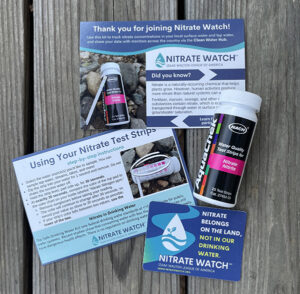 Your kit will include a bottle containing 25 nitrate test strips which you can use to test your water source(s) throughout the year. You’ll also receive postcards explaining how to use your nitrate test strips and how to share your Nitrate Watch results on the Clean Water Hub.
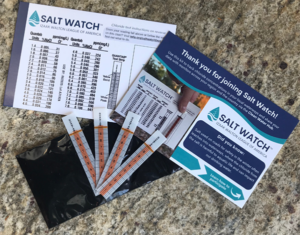 Your kit will include four test strips so you can test your waterway throughout the season. You’ll also receive a chart to help you interpret your results and a postcard with instructions for completing a Salt Watch test and reporting your findings.