A Shared Conservation Legacy: Izaak Walton League and Outdoor Writers Association of America
By Phil Bloom
What do Arthur Carhart, “Ding” Darling, Nash Buckingham, Olaus Murie, Sigurd Olson and Anne LaBastille have in common?
They were conservation giants.
They also were members of the Outdoor Writers Association of America, the premier organization of professional outdoor communicators over the past century. The aforementioned individuals and legions of OWAA members have been front and center championing conservation causes through their writing, broadcasting, artwork, photography and other media.
Generations of outdoor communicators have helped weave conservation deeply into the fabric of OWAA despite the organization having other priorities in its infancy.
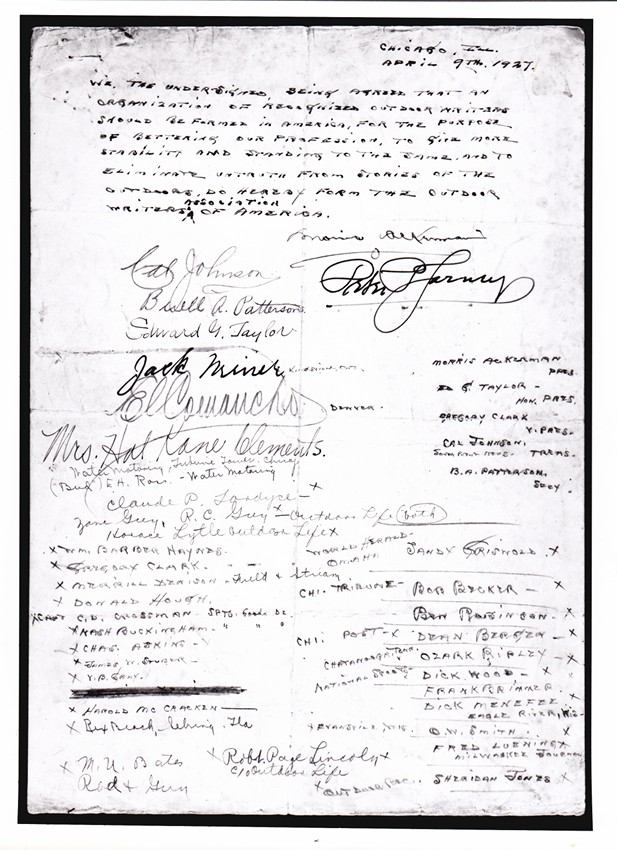
Some of the leading figures in the fledgling field of outdoor writing were attending the Izaak Walton League convention banquet at Chicago’s Hotel Sherman on April 9, 1927. One of them, Morris Ackerman, used the back of the banquet menu to write out the Bill of Organization that formed OWAA.
It’s worth noting that communicating with the public was a priority for both organizations. Buckingham, Carhart, Darling, Murie and Olson each wrote at least a half dozen articles for the Izaak Walton League’s magazine, Outdoor America. And just before founding the League in 1922, Will Dilg worked as editor at a hunting and fishing magazine called Outers’ Recreation (which merged with Outdoor Life a few years later).
A Century Milestone for Conservation
A month after OWAA was formed, Sporting Goods Dealer, a trade publication, reported on the new organization and noted it “will also endeavor to further the work of conservation.” It took a while for OWAA to get its footing, but decade after decade since then, the calling card of its members has been a willingness to tackle conservation issues head on.
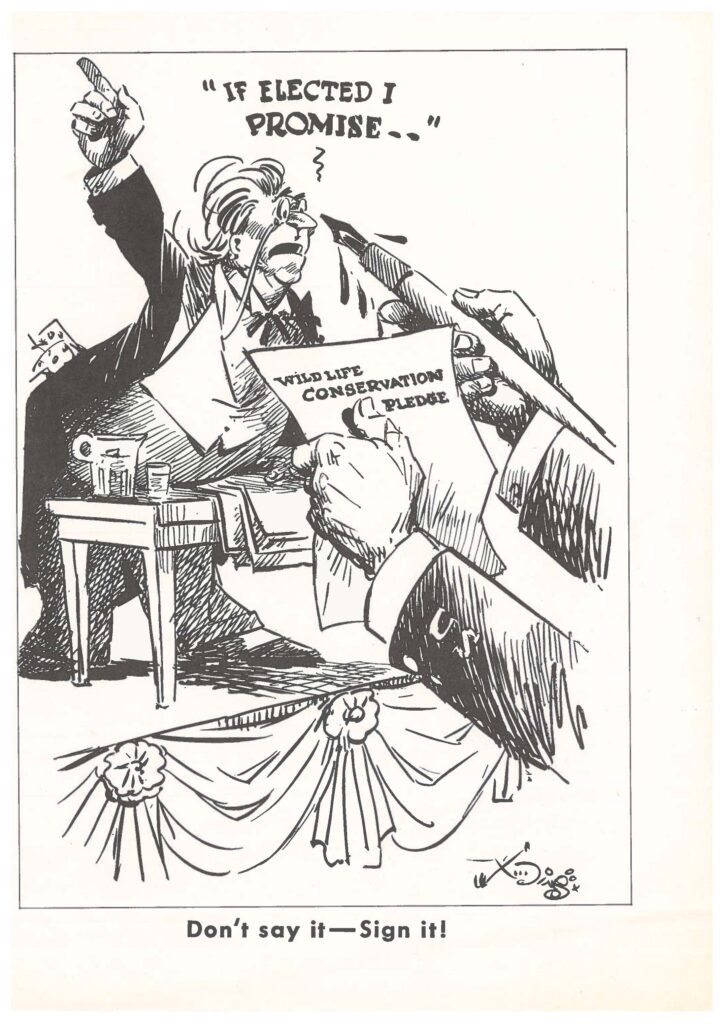
In the 1920s, Nash Buckingham was preaching about the need to enforce waterfowl regulations to combat “game hogs.” At the same time, Ding Darling, who later on designed the first federal Duck Stamp, knocked out editorial cartoons for the Des Moines Register that were stinging indictments of deforestation and other wanton acts of despoiling natural resources.
Outdoor writers continued pushing a conservation message in the 1930s, including support for the Pittman-Robertson Act of 1937 that has been the backbone of funding for countless wildlife restoration projects across the nation.
A year later, some OWAA members questioned the growing practice of contests that awarded prizes for the most fish caught. “I bitterly oppose all such exploitation as mass destruction,” Buckingham wrote. “Worse, they impair national outdoor character, already at a low ebb.”
What Buckingham, Darling and others were doing individually on the conservation front soon was wrapped in OWAA’s banner.
When Dave Roberts of the Cincinnati Enquirer became OWAA’s president in 1940, he wrote: “The Outdoor Writers Association of America can—and we believe will—be one of the most influential of all the forces working for restoration and conservation of wildlife.”
One of the first actions was an OWAA resolution calling for a national advisory board on conservation. But the group’s conservation advocacy shifted into overdrive under the leadership of J. Hammond Brown of the Baltimore Sun.
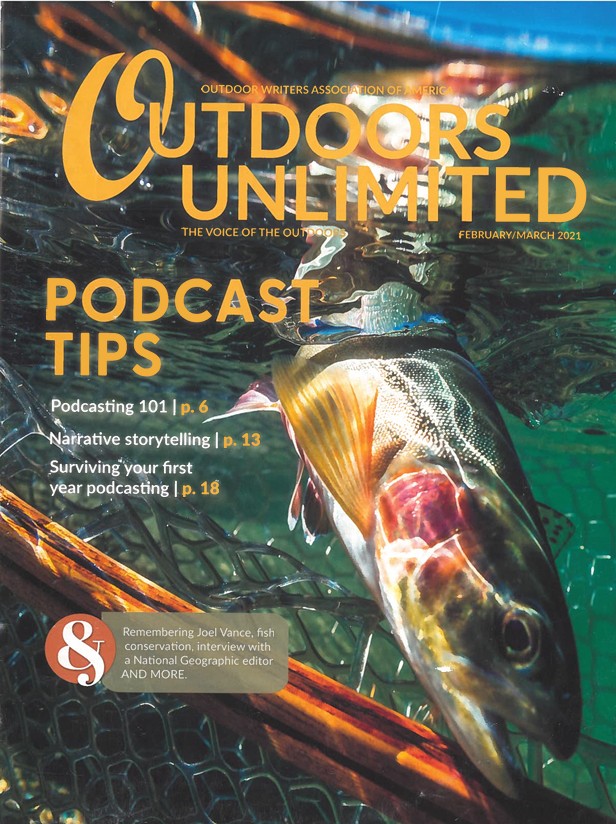
Brown succeeded Roberts as OWAA president in 1941 and, except for one year, held that seat until his death in 1955. He used his dual role of president and editor of the member magazine, Outdoors Unlimited, as a pulpit to shape OWAA into an unapologetic lobbying dynamo on conservation issues.
“The chance to throw the entire weight and coverage of our members with their diversified avenues of approach to national publicity is really the first purpose of our organization, its primary reason for existence,” Brown wrote in 1941. “We must be ready to use it forcefully but wisely; must exercise it promptly but with unity.”
OWAA began adopting resolutions and policy statements at its annual meetings, some of which included:
- Halting primeval timber cutting in northeast Louisiana to save the ivory-billed woodpecker.
- Endorsing flyway management of migratory birds and establishing an advisory board to assist the Federal government with waterfowl regulations.
- Opposing plans to move U.S. Fish & Wildlife Service headquarters from Washington, D.C. to Chicago.
- Supporting the Dingell-Johnson fisheries restoration bill.
- Calling for proper management practices to preserve Florida’s Everglades.
- Recognizing hazards to wildlife, water, vegetation through indiscriminate use of certain insecticides and herbicides.
- Opposing a proposal to abolish Parker River National Wildlife Refuge in Massachusetts.
- Urging passage of the Great Lakes Fisheries Treaty with Canada.
- Supporting establishment of the American-Canadian Quetico-Superior wilderness.
The organization also developed formal policy positions on water use, land use and other practices impacting the American outdoor recreational landscape.
To put weight behind the actions, Brown threw open the door to OWAA membership for anyone with a remote connection to the outdoors. By the early 1950s, OWAA ranks approached 1,500—a tenfold increase from 1941. But many newcomers were not outdoor writers. Brown identified those that weren’t as “conservationists” because they provided him with the numbers he felt necessary for OWAA to get the attention of government officials.
“Ham Brown injected real life into a dormant outfit and put it slap-dab into the middle of the conservation map,” OWAA charter member Henry Davis said.
Although well intentioned, Brown’s approach didn’t sit well with the established segment of OWAA that wrote about the outdoors in magazines and newspapers or had radio and television shows. And they didn’t like, as one veteran member said, “that even a plumber with $3 can become a member.”
Another point of contention was the “conservationist” group had voting status equal to OWAA’s professional media, prompting Jack Van Coevering of the Detroit Free Press to complain that “the tail was wagging the dog.”
After Brown’s death, OWAA revamped its constitution in 1957 and reemphasized the founding principle of bettering the profession of outdoor writing.
The Voice of the Outdoors
OWAA never abandoned conservation and has pursued ways other than policy statements and resolutions to keep that priority front and center.
One way is the “Jade of Chiefs Award” that is given to an individual “for truly outstanding service to conservation and outdoor preservation.”
Arthur Carhart was the first recipient in 1958. Other recipients include Buckingham, LaBastille, Erwin Bauer, Leonard Lee Rue III, the Madsons (father John and son Chris), the Izaak Walton League’s Jack Lorenz and 53 others. These recipients form the Circle of Chiefs, who are tasked by the OWAA Board of Directors to present conservation issues to the membership through articles in Outdoors Unlimited.
The Chiefs have addressed myriad conservation topics, including climate change, wetlands protection, the Endangered Species Act, roadless areas, wilderness, habitat loss and acid rain.
In a 2014 article in Outdoor America, Tom Sadler commented, “Outdoor communicators are the eyes and ears for the general public when it comes to things that affect soil, air, woods, waters and wildlife.” Sadler was OWAA executive director at the time, and he had previously worked at the Izaak Walton League as conservation director.
OWAA also recognizes conservation issues by including it as a topic in the annual Excellence In Craft Contest. Invariably, the contest draws more entries than any other topic, whether in the category or blogs, magazine and newspaper writing, radio and podcasts and television.
Like their predecessors, current members Christine Peterson, Michael Furtman, Chris Madson, Ted Williams, Ashley Stimpson, Kris Millgate, Dan Small and countless others uphold this tradition of addressing conservation topics in their work.
All of which underscores the OWAA slogan “Voice of the Outdoors” as a commitment to inform the public on conservation matters just as its members have done for nearly a century.
“This incredible milestone represents nearly a century of passion, vision, and an unwavering commitment to the outdoors, conservation, and the art of storytelling,” current OWAA president Colleen Miniuk said. “Much has changed in the outdoor industry in the past 99 years, yet our mission remains as relevant as ever.
“Now, more than ever, our love of the natural world, our voices in the media, and our dedication to truth and integrity matter. Every story we tell—through articles, photos, books, film, art, digital media, and beyond—helps give a voice to the outdoors and expand our collective impact.”
Phil Bloom is a two-time past president of Outdoor Writers Association of America and has been a member for 35 years.
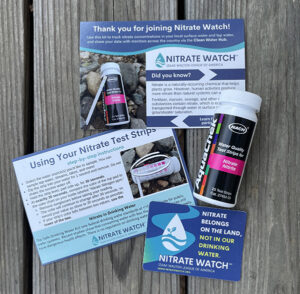 Your kit will include a bottle containing 25 nitrate test strips which you can use to test your water source(s) throughout the year. You’ll also receive postcards explaining how to use your nitrate test strips and how to share your Nitrate Watch results on the Clean Water Hub.
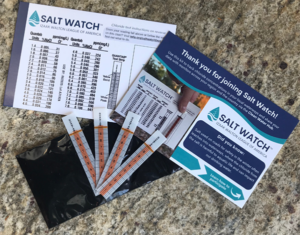 Your kit will include four test strips so you can test your waterway throughout the season. You’ll also receive a chart to help you interpret your results and a postcard with instructions for completing a Salt Watch test and reporting your findings.