Red Rose Chapter Works on Setting Things Right for the American Chestnut
Author: Derek Pritts
Outdoor America 2026, Issue 3
Twenty years ago, it started with a few American chestnut seedlings and more than a few dreams of what the American chestnut tree could become. Now those dreams are blossoming into reality at the Izaak Walton League’s Lancaster Red Rose Chapter in Pennsylvania.
A few centuries ago, the forests of the Appalachian Mountains from Maine to Georgia held about three billion American chestnut trees, Castanea dentata. The American chestnut was a keystone species, a vital source of rot-resistant timber and a major food source for wildlife and humans.
Then an Asian parasitic fungus (Cryphonectria parasitica) that came to be known as chestnut blight, accidentally introduced in 1904 in New York, wiped out nearly the entire population nationwide within 50 years. The American chestnut tree has no resistance to this disease. Various attempts at hybridizing American trees with Asian chestnuts have not produced trees that can resist the blight and have the highly prized timber qualities of the American chestnut.
By 2001, word was circulating within the scientific community about the potential development of a blight-tolerant American chestnut at State University of New York College of Environmental Science and Forestry (SUNY-ESF) in Syracuse, New York.
As a League member at that time, I made a simple pitch to the Red Rose Chapter leadership. “Humans created this existential threat to an American species. It’s time to set things right.”
The Chapter stepped up to help save the vanishing American chestnut.
In the Chapter’s first tree grove, a quartet of members put wild-type, indigenous American chestnut seedlings into the ground. The seedlings came from the nuts of heirloom American trees. Although infected with the foreign fungal disease, the strongest surviving American trees were still producing a few precious “gold nuggets” of American chestnuts, native stock Castanea dentata.
Richard “Dick” Deibert, now deceased, and I served as the initial team leaders. I put my Penn State degree in Agricultural Sciences to work, and together we moved forward with the American pioneer spirit: Do the work. Dig hard. Plant many so a few survive.
Then wait. Wait for the breakthrough—the day when the American chestnut tree could once again be restored without foreign gene intervention. It would take patience, persistence and no small measure of faith in their trees and their efforts.
Field trial may produce a breakthrough
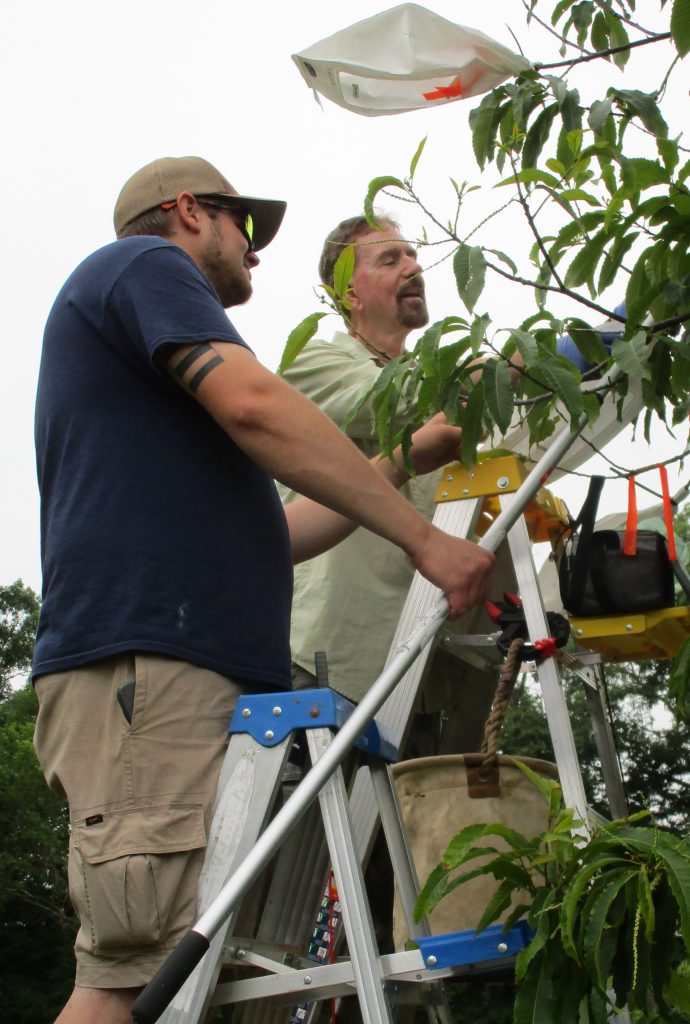
A potential breakthrough came in 2026, the 250th anniversary of the Declaration of Independence. The Lancaster Red Rose Chapter was chosen as one of only a half-dozen sites across the Eastern U.S. to participate in a historic field trial: pollinating its pure American chestnut trees with the first release of blight-tolerant pollen.
That pollen represents more than two decades of painstaking research and planting. While the Chapter was putting American chestnut trees into the ground, scientists at SUNY-ESF were working to develop the blight-tolerant pollen that might finally give those trees, and the species itself, a fighting chance.
Today, newer Chapter members pitch in. Tara and Dale Etzweiler both marveled at the passion that had carried the effort forward for two decades. On a recent evening, as dusk settled over the grove, Dale Etzweiler reflected on what had brought them to that moment. His hope was simple: that the efforts of a few today would one day benefit many in the future.
Carey Specht, the Chapter’s first female board chair and a recipient of the Izaak Walton League’s Judge John W. Tobin Chapter Volunteer Appreciation Award, found the pollination process both enlightening and deeply meaningful. She was thrilled to have the opportunity to take part.
Climbing down a stepladder to take a break on a hot day in June, Specht sat in the shade and recorded the colossal amount of scientific data being called down by those still working high in the trees.
She dabbed at the perspiration on her face, looked across the grove and quietly mused, “The end of the rainbow might be right here in Lebanon County, Pennsylvania.”
K. Derek Pritts has been a League member for more than two decades with a lifelong passion for restoring the American chestnut. Pritts is a retired waterways conservation officer with the Pennsylvania Fish and Boat Commission. He’s a freelance writer, photographer and author of several books.
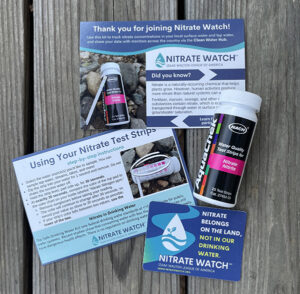 Your kit will include a bottle containing 25 nitrate test strips which you can use to test your water source(s) throughout the year. You’ll also receive postcards explaining how to use your nitrate test strips and how to share your Nitrate Watch results on the Clean Water Hub.
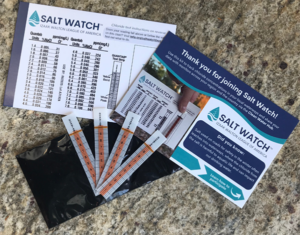 Your kit will include four test strips so you can test your waterway throughout the season. You’ll also receive a chart to help you interpret your results and a postcard with instructions for completing a Salt Watch test and reporting your findings.