Meet a Monitor: Sarah Coradetti
By: Maggie Dombroski, Mid-Atlantic Save Our Streams Coordinator

Sarah Coradetti is a Salt Watch and Virginia Save Our Streams monitor in Prince William County, Virginia. Currently an ESOL (English for Speakers of Other Languages) teacher at an elementary school, Sarah has taught English and science and studied water resources all over the world. As the founder of her HOA’s landscape committee, she is also actively involved in educating her community about the impacts of road salt on infrastructure, vegetation, and water quality.
A Winter Storm Sparks Action
The early 2026 “snowcrete” storm that blanketed much of the Mid-Atlantic in a thick layer of snow-turned-to-frozen-solid ice provided the perfect opportunity for Sarah to use the rapport she’d built to take action within her HOA. She didn’t let the weather stop her from testing the ponds and streams – “I was out there hacking away at the ice to get to the water, and I got some really good data,” she said.

Salt was over-applied in a lot of places, but it was particularly bad in Sarah’s neighborhood. Their contractor was having an issue with their spreader, so they resorted to shoveling salt out of the back of a truck, leaving behind piles. Sarah swept up what she could around her house, but she couldn’t tackle the whole neighborhood. She took pictures of the oversalting and sent it to the neighborhood’s property manager along with her Salt Watch data, imploring them to take action. The property manager contacted the contractor, who then came back and swept up some of the salt.
After that exchange, the property manager, who is an editor of a regional magazine for community association leadership, asked Sarah to write an article about smart salting for an issue on winter preparation. Sarah also wrote an article for the neighborhood’s newsletter using her Salt Watch data and resources from the Izaak Walton League’s resource library. Sarah is guessing the HOA manager shared her articles with their winter maintenance contractor, because before their winter maintenance contract negotiation came up, the contractor sent an email with bullet points of smart salting practices they planned to implement in the upcoming season.
“I was really excited, because that’s the first time that the HOA, I felt like, was proactive,” Sarah reports, “By that time I had established enough of a relationship, I think, with them that they actually did listen…If I had just jumped into this right away, I don’t think I would have gotten the same kind of response.”
The Revealing Power of Data
Part of what set Sarah up to respond to the winter storm and oversalting event of early 2026 was consistent chemical monitoring at her four neighborhood sites – upstream and downstream of a stormwater pond, the pond itself, and another stream that goes through wooded areas. She chose these sites because she was curious to see how they would compare to one another. Through her data collection, Sarah began to notice an intriguing trend – “everything seemed fine, except the salt…It wasn’t really on my radar, that salt was going to be our big issue. I thought maybe nitrate or other things, right? That was kind of like a red flag for me.”
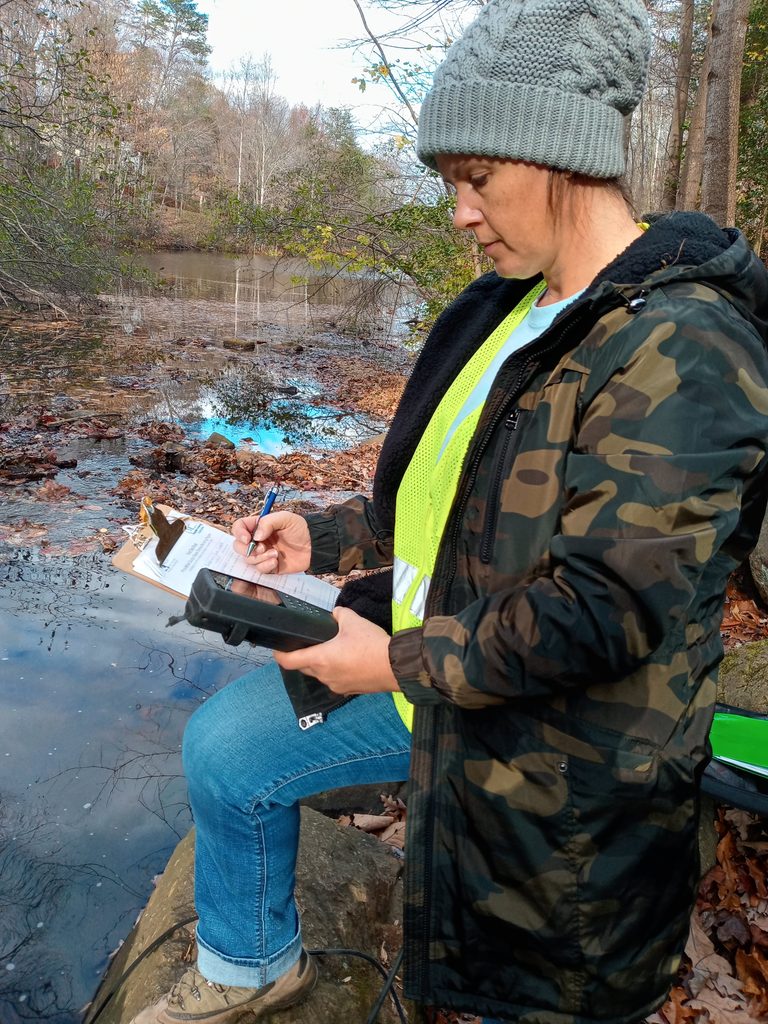
Up to that point she had been monitoring conductivity (a proxy for chloride) using a probe that she borrowed from the Prince William Soil & Water Conservation District. When she saw the high readings, she decided to incorporate Salt Watch (which measures chloride from winter salt pollution) into her monitoring routine as well, both to corroborate the conductivity data and to take readings more often, since she was only able to borrow the probe once a month.
Through this monitoring, Sarah has seen a correlation between salt levels and benthic macroinvertebrate scores at the two sites where she conducts Virginia Save Our Streams biological monitoring. “I can’t say anything about causation, but the bio data does correlate to the salt data,” Sarah explains, “The saltier stream is the one that has the worse biological survey scores, and most consistently.”
The stream that has higher salt and receives lower macroinvertebrate scores comes into the neighborhood through areas of impervious surface, like parking lots, and other stormwater ponds. Sarah notes that, “[The water] is coming in salty, and then we add our own salt,” to sidewalks and parking areas during winter storm events, which runs off into the local streams. The stream that fares better is more wooded, and Sarah has noticed that it bounces back to baseline faster whenever there are chloride spikes from winter salt runoff.
Turning Data into Community Action
Sarah began using her findings to educate her community and advocate for smart salting practices within her HOA. In addition to consistent data collection at local sites, the key to effective HOA advocacy has been relationship building with the HOA board and broader community. She learned this through experience, sharing that “initially when our committee was asking [the HOA board] to do things or to not do things, we got a lot of pushback. There was a lot of defensiveness.”
Even after the pushback, Sarah and the landscape committee she founded continued to show up to meetings and be involved in the regular processes of the HOA. The landscape committee also contributes an article to the newsletter each month on a variety of topics, including native and invasive plants, community science opportunities, and winter salt pollution. Through these articles the committee began to build rapport in the community, but it was hard to make individual connections. Sarah notes, “I think with a lot of communities in the U.S, people tend to kind of, be in their homes a lot more, and not know their neighbors as well, so it’s hard to have one-on-one conversations.”
However, monitoring in the community has provided a natural opportunity for these conversations. The path around the stormwater pond is a popular place for community members to walk. When people see Sarah monitoring there, they often ask how the pond is doing, which provides the perfect chance to raise awareness and start conversations. In fact, Sarah and another Master Naturalist were recently out by the pond filming a promo video for an event when a father and his son passed by. He ended up offering to be their videographer, and they got his contact to invite him and his son to come out and participate in macroinvertebrate monitoring.
A Passion for Protecting Local Ecosystems
Sarah has always been involved in monitoring and protecting aquatic ecosystems one way or the other. As a middle school science teacher in Northern Virginia, her classes participated in Trout Unlimited’ s Trout in the Classroom program. When she taught 4th grade, her class grew underwater grasses for the Grasses for the Masses program and got to take a field trip to Mason Neck State Park to plant them in the Potomac River.

She got her start with volunteer monitoring when her own children were little, and she saw a flyer in the local library for bluebird box monitoring with the Prince William Conservation Alliance. Through that experience, she also got involved in chemical and biological stream monitoring through the Prince William Soil & Water Conservation District, and became a certified Virginia Save Our Streams monitor.
Around the same time Sarah discovered her passion for stream monitoring, she noticed something missing on her daily walks. Her HOA was filled with beautiful, forested trails, but there was a distinct lack of diversity and plenty of invasive species among the vegetation. “I enjoyed [walking the trails], and I was just thinking, oh, wouldn’t it be nice if we had Virginia Bluebells?” Sarah recalls. When she reached out to the HOA to ask if anyone was planting native species around the trails, they told her no—but invited her to start a group herself. She seized the opportunity, founded the landscape committee within her HOA, and has been working to rehabilitate the neighborhood ecosystem ever since.
The landscape committee started off with a focus on beautifying and adding plants and has evolved over time to include promoting a range of environmentally conscious practices. One of its facets is stream monitoring, which started when Sarah realized she could bring her stream monitoring knowledge to the waterways in her neighborhood.
Sarah uses water monitoring as an opportunity to involve the community. She shares the events within her HOA and has made connections with a local scout troop and a teacher at a nearby high school who oversees student clubs. “There are a few people that will come when they can, and then I get new people. Every time I might get one or two new people trying it out.”
“I have a regular now,” Sarah reports – a third grader who has come out to help 4 times!
A Global Perspective on Water
In college, Sarah started off as a biology major with a desire to work in water resource management. She had the chance to study this topic in both Venezuela and Nepal. While studying abroad in Nepal, she became fascinated by the social science aspect of managing water resources.
“In Nepal and Kathmandu, there’s sacred geography everywhere, and rivers are really, really important spiritually and they signify purity. But a lot of the rivers, especially the urban rivers, are just choked with garbage and sewage, and so how do you rectify when your religion says you should be purifying yourself by bathing in these rivers when they’re full of human feces.”
“How can people, we as a collective, understand nature, love nature to the point of actually taking action and doing something different?”
Sarah was still interested in the natural science part of water resources but realized that in order to actually influence change for the better, she needed to understand cultures and how people think. She ended up graduating as an anthropology major and returning to Nepal as a Residential Coordinator for Cornell University’s Nepal study abroad program, but her heart was in Venezuela with someone she had met while studying abroad there. So, she moved to Venezuela, got married, and became an English teacher there. She completed a master’s degree in teaching English and has been teaching at public schools ever since.
How You Can Make a Difference
If you want to make a change to protect water quality in your neighborhood, Sarah says that water monitoring is a great way to start – “just try it, you don’t have anything to lose!” She recommends starting with one nearby site that you can easily commit to monitoring on a regular basis.
If you live in an HOA or condo association, Sarah highlights the importance of building a familiar relationship with the property manager and the board. A great way to start is by regularly attending meetings and staying involved in community processes. “Earn the respect of the board members so they’ll listen to you and be open-minded,” she encourages.
Lastly, when you have the opportunity to communicate about salt pollution and smart salt practices, don’t reinvent the wheel! Use the fact sheets and other resources on the Izaak Walton League’s resource library. “That’s super helpful if you’re like, well, what do I do now? How do I advocate? What do I say? [The resource library] was my go-to when I discovered [it]. I was like, oh my gosh, I don’t have to make it up on my own.”
You can get started right now!
All photos courtesy of Sarah Coradetti.
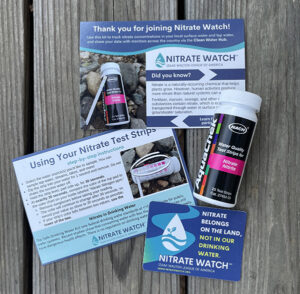 Your kit will include a bottle containing 25 nitrate test strips which you can use to test your water source(s) throughout the year. You’ll also receive postcards explaining how to use your nitrate test strips and how to share your Nitrate Watch results on the Clean Water Hub.
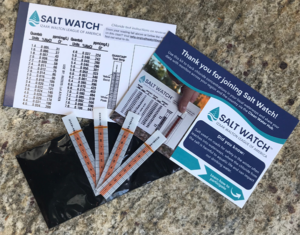 Your kit will include four test strips so you can test your waterway throughout the season. You’ll also receive a chart to help you interpret your results and a postcard with instructions for completing a Salt Watch test and reporting your findings.