When Legislative Losses can be Wins
Author: Abby Hileman, Salt Watch Coordinator
Whether a bill succeeds or fails to pass, it often isn’t the final chapter. To start with a wonderful cliché, “It’s all about the journey and not about the destination.” This underlying sentiment undoubtedly occurs throughout every facet of life. For grassroots lobbying, it is as much about community building and connections made as it is about the message that is being promoted and disseminated. The same can often be said about legislation, especially at the state level, where grassroots energy can reshape agency actions and public awareness—even when a specific bill gets stuck in committee.
Early Legislation and the Scale of the Challenge
To understand the power of persistence, we must look at the scale of the challenge we face. In the United States, winter salt was first used to melt snow and ice in New Hampshire in 1938. A few years later, around 5,000 tons of salt were used across the nation to melt snow and ice in the winter months. Today, between 20 and 30 million tons of salt are used each winter in the United States.
Chloride, a component of most winter salt deicers, is a known pervasive pollutant. It persists in soils, waterways, and groundwater for decades after it enters the environment. Along the way, it corrodes infrastructure, pollutes drinking water, harms native plants, and kills freshwater aquatic life. Turning the tide on millions of tons of salt requires systemic change, and that kind of shift takes time.
Seeds of Systemic Change
We can see the seeds of this change in early state initiatives. In 2010, Senators in Maryland put forward legislation to direct the State Highway Administration (SHA) to develop and update a “best practices” guidance document for local jurisdictions to minimize road salt runoff. This specific legislative mandate did not pass and was seen at the time as potentially diverting limited staff resources and increasing local government expenditures without a clear funding source.
However, the effort wasn’t a loss. The SHA eventually developed its own Statewide Salt Management Plan that optimizes the use of winter salt and liquid deicers (salt brine) during winter storms while minimizing environmental impacts on local waterways, groundwater, and the Chesapeake Bay.
Relationship Building and the Power of a Single Connection
For any sort of legislation, there is a lot of lead-up and anticipation for what happens to a bill, no matter what side of the aisle you are on. Bills are often months and sometimes years in the making. And they all start with an idea and oftentimes just one person. To quote The Lorax, “Unless someone cares a whole awful lot, nothing is going to get better. It’s not.” In the case of smart salting legislation in Maryland, the momentum around winter salt reductions and smart salting practices started as a result of the Izaak Walton League of America’s Salt Watch program.
A Salt Watch volunteer local to the League’s National Office Headquarters in Gaithersburg, Maryland happened to be neighbors with a state delegate. That single connection bridged the gap between community science and public policy. After initial conversations around the issue of winter salt pollution, the Delegate was invited to go water monitoring to see the impact of winter salt on local waterways firsthand. Seeing the spikes in pollution transformed a theoretical environmental issue into a clear, personal priority for the lawmaker.
A Peek Behind the Legislative Process
The process behind getting legislation on the table involves getting people to the table. It involves building relationships with legislators well before a bill idea is even floated. If you are part of an organization, inviting community members and local and state decisionmakers to events you are hosting, such as water monitoring trips or hikes, are great ways to start conversations and let them know you are part of the community and what you stand for. Making connections and cultivating partnerships with neighboring organizations are also great ideas to pool resources and amplify the collective voice. Once these relationships are established, keep them going.
If you have an idea for a bill, speak with legislators who might carry the idea forward. Meeting with legislators at the end of a legislative session to prepare for the next allows for deeper thinking on what options could be floated. Determine other proponents for the bill and who might be in opposition and have conversations with each group to try to get everyone on the same page and in favor of the legislation.
By this point, the bill should be written and will eventually be submitted to an appropriate committee in either the House or Senate (depending on whether the bill sponsor is a State Delegate or Senator). Committee members will discuss the bill and decide if there are amendments to be made or if they are in favor or against the bill. Even with amendments, a bill can move forward out of committee to the House or Senate floor. From there, a bill will be discussed and can move to the floor of the other chamber and eventually to the Governor’s desk to be signed. Every step along the way, advocates for the bill are encouraged to show their support by testifying for bills verbally in-person, online, or in writing.
Silver Linings with Legislative Loss
That initial outreach in Maryland eventually led to smart salting bills being introduced in 2022 (House and Senate), 2023, 2024, and 2025. These bills aimed to establish a professional certification training program for salt applicators, mandate salt reporting requirements for state and local agencies, and adopt regulations for proper outdoor storage of road salt. None of these bills passed. Opponents raised concerns over unfunded mandates and state agencies worried about the administrative costs of mandatory enforcement.
However, if you look closer at those failed bills, you can see that it isn’t the end of the chapter. When the mandatory professional certification training program for salt applicators bill failed, the Maryland Department of the Environment responded by rolling out a comprehensive voluntary training approach that was launched in 2023–2024. When the reporting mandate failed, the momentum shifted behind the scenes, leading to MS4 (Municipal Separate Storm Sewer System) stormwater permit changes in 2026 that now have a salt reporting requirement. With every single push, the grassroots network grew larger, public awareness skyrocketed, and the culture around winter salt usage fundamentally shifted.
The Future Starts in Your Backyard
Progress is rarely a straight line. In almost every single bill that was put forward in Maryland, something resulted. It hasn’t yet been the bills themselves signed into law, but in most cases a similar result has occurred behind the scenes, which has made for meaningful changes to salting practices in the state and the perception of salt pollution. Each push for legislation has rallied the grassroots network, which has in turn raised awareness of the problem, and has brought meaningful solutions to people everywhere.
Although it seems like a long fight already in Maryland, organizations in other states like Minnesota have been trying to get limited liability legislation passed for a decade. This legislation, similar to New Hampshire’s gold-standard Green SnowPro program, protects certified winter maintenance professionals from slip-and-fall lawsuits if they follow smart salting best practices and keep diligent records. In Wisconsin, advocates are closer than ever to the finish line with similar legislation. What keeps these movements alive is not the guarantee of immediate political victory, but rather the unwavering passion, commitment, and connections of community members who continue the push for meaningful legislation that can reduce pollution and keep us safe during the winter season.
A cleaner, safer winter season does not start on a governor’s desk. It starts with people like you.
Join the Salt Watch program today to claim your free water testing kit, discover the health of your local stream, and learn how you can become the spark for meaningful change in your community.
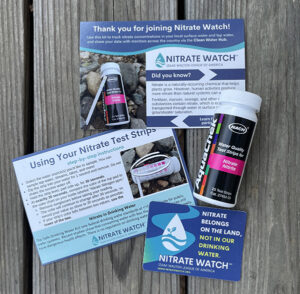 Your kit will include a bottle containing 25 nitrate test strips which you can use to test your water source(s) throughout the year. You’ll also receive postcards explaining how to use your nitrate test strips and how to share your Nitrate Watch results on the Clean Water Hub.
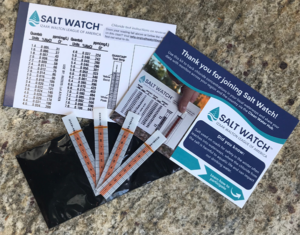 Your kit will include four test strips so you can test your waterway throughout the season. You’ll also receive a chart to help you interpret your results and a postcard with instructions for completing a Salt Watch test and reporting your findings.