Double Trouble: Coupling Climate Change and Nitrate Pollution
By Heather Wilson, Save Our Streams Coordinator and Kate Hansen, Agriculture Programs Director
One of the biggest environmental stories to affect Iowans in 2025 was the first-if-its-kind lawn-watering ban issued by Central Iowa Water Works for more than 600,000 residents in the Des Moines area. The restriction was triggered not by a water shortage, but by dangerously high nitrate levels in the Raccoon and Des Moines rivers, which limited the utility’s ability to process safe drinking water quickly enough to meet high summer demand.
Then in the early months of 2026, Iowans received surprising news. Central Iowa Water Works was forced to turn on its nitrate removal facility again—this time, in January. The reason? The same rivers contained unseasonably high levels of nitrate pollution—in excess of the EPA’s 10 mg/L drinking water standard for nitrate.
This was the second time in history that the nitrate removal facility has been turned on in January. The facility would run for roughly 90% of the time between January and April 2026.
Nitrate spikes in rivers are something that Iowans and other residents of the Mississippi River Basin have come to expect in the summer. Nitrate spikes in the winter—not so common. Many Iowans have taken notice of this rare event and find it concerning.
Until recently, nitrate spikes in the winter were almost unheard of, says Christine Curry, outreach coordinator for the Iowa Division of the Izaak Walton League. “At the same time, Iowa now ranks second in the nation for cancer, which makes the conversation about water quality and environmental health even more urgent.”
The explanation for the high nitrate levels in the Raccoon and Des Moines Rivers this winter is complex, but one important factor is the weather. Curry explains, “with heavier rainfalls mixed with periods of drought at almost any time of year, and thousands of pounds of fertilizers and chemicals applied to the land, the pressures add up.”
In a typical year, bitter winter temperatures would cause the ground and underground agricultural drainage tile to freeze. Wet weather in 2025 coupled with a milder winter meant that nitrate-rich water from agricultural fields was able to continue flowing to waterways, even during the winter.
How much is Harmful?
The drinking water standard for nitrate (10 mg/L nitrate-N) was established to prevent cases of methemoglobinemia, or blue baby syndrome. This is a disorder that impacts the way oxygen is transported by blood, causing skin to turn blue and leading to serious illness or death, particularly in infants.
Unfortunately, blue baby syndrome is not the only health impact associated with consuming high levels of nitrate. Increased incidence of thyroid disease, pre-term births, neural tube birth defects and bladder, ovarian and colon cancers have all been linked to the consumption of drinking water contaminated with nitrate. This is the conclusion of a 2018 analysis of 30 studies on the effects of nitrate consumption on human health published in the International Journal of Environmental Research and Public Health.
The authors of that analysis state that “many studies observed increased risk with ingestion of water nitrate levels that were below regulatory limits,” especially with prolonged exposure to nitrate in drinking water. These findings raise serious questions about whether the 10 mg/L drinking water standard adequately protects public health.
Climate and Nitrate pollution are tightly linked
This link between nitrate in waterways and the prevailing temperature and precipitation trends hints at a larger connection between nitrate pollution and climate. These two environmental issues, each formidable on their own, are in fact intimately intertwined.
The sources of nitrate pollution are, in some cases, the same as the causes of climate change.
The creation of synthetic nitrogen fertilizer, a primary source of nitrate pollution, involves significant consumption of fossil fuels and emission of greenhouse gases. The Haber-Bosch process used to create ammonia (NH3) must take place under high temperature and pressure, conditions that require immense energy input. This energy is primarily obtained from power plants that burn fossil fuels and release carbon dioxide (CO2). Moreover, the primary raw material used to obtain hydrogen for the Haber-Bosch process is methane (CH4), another potent greenhouse gas.
Once it makes it to the field, the application of nitrogen fertilizer also has a large carbon footprint. When synthetic nitrogen fertilizer is applied, microbes in the soil can convert the nitrogenous compounds to nitrous oxide (N2O), a greenhouse gas with roughly 300 times the warming potential of carbon dioxide. Urea, a commonly used synthetic nitrogen fertilizer, also releases carbon dioxide as it breaks down in the soil.
To make things worse, fertilizer is often applied in amounts that far exceed what crops can absorb, further increasing greenhouse gas emissions. A February 2026 report from the Union of Concerned Scientists estimates that corn–soybean producers in the U.S. overapplied between 3.5 million and 5.8 million metric tons of synthetic nitrogen fertilizer in 2023.
The heat-trapping emissions generated by the application of this excess fertilizer is equivalent to roughly 8.4 million to 14 million gas-powered cars driven for a year, according to the report. Globally, the production, transportation and application of synthetic nitrogen fertilizers is estimated to be responsible for the emission of over one billion metric tons of carbon dioxide equivalent (CO2e) each year.
Nitrogen oxides (NOx) are gaseous molecules created by the breakdown of fertilizers in soil and the burning of fossil fuels. These gases are responsible for yet another source of nitrate pollution in water called atmospheric deposition. Roughly 26 percent of nitrogen contributing to the massive dead zone in the Gulf of Mexico comes from this process.
Atmospheric deposition is the transfer of air pollutants to the Earth’s soil and water. The effect of atmospheric deposition on ecosystems is sometimes referred to as “acid rain.” Nitrogen oxides can react in the atmosphere to form nitric acid (HNO3), which dissolves in precipitation, falling with rain or snow in the form of nitrate (NO3-). When this precipitation reaches the Earth’s surface, it adds nitrate pollution to waterways. The contribution to overall nitrate pollution varies annually and from place to place.
A warming planet fuels nitrate pollution
Climate change also has the effect of intensifying problems associated with nitrate pollution.
Warm soil speeds nitrate mineralization.
One of the processes that creates nitrate from organic nitrogen is mineralization. This is the process by which soil microbes convert nitrogen found in soil organic matter, manure and plant residues into forms of nitrogen that are available to plants, including nitrate. Warmer temperatures speed up the rate at which microbes can break down organic material, leading to a faster rate of nitrogen mineralization. The result: more nitrate is available to be taken up by plants or transported to our waterways.
Warm water breeds algal blooms.
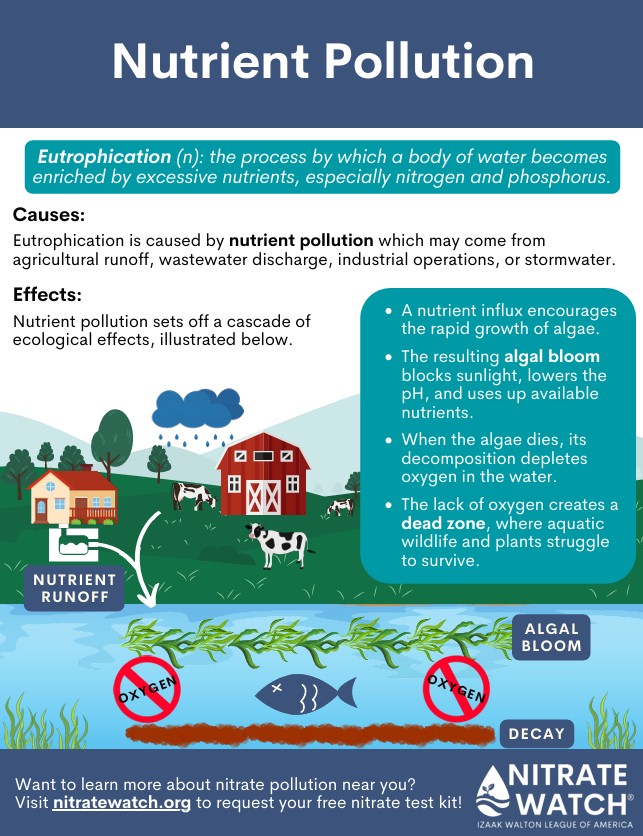
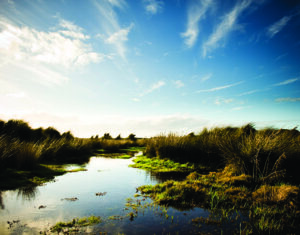
Algal blooms are a well-known consequence of nitrate (and phosphorus) pollution in waterways. Algae is an opportunistic organism that will take advantage of an influx of nutrient pollution and grow rapidly, giving water an unsightly green appearance, blocking light from penetrating lower into the water column and consuming oxygen required for fish and other organisms to thrive.
In some cases, algal blooms can harbor toxic cyanobacteria, making them even more harmful to humans and the environment. Some types of cyanobacteria, also called “blue-green algae,” create compounds called cyanotoxins which can be dangerous and even deadly to humans or animals that encounter them.
Algal blooms are fed by nutrient pollution, but they are nurtured by warming temperatures. Algae grow and reproduce best under warm, stagnant water conditions. As global water temperatures increase, there is a corresponding increase in the size, frequency and duration of algal blooms.
Drought and downpour mobilize nitrate.
Climate change is characterized by more than just warming temperatures. It is also marked by more extreme precipitation patterns, where periods of severe drought are punctuated by heavy rain. During a drought, plants take up nitrate less efficiently, leaving more nitrate behind in the soil. During a heavy rain,
this excess nitrate is rapidly washed away, polluting waterways instead of feeding plants. As patterns of drought and downpour have become more common, the transport of nitrate from farm fields into waterways has too.
The solutions are also linked
Climate change and nitrate pollution share more than common origins and impacts. While climate change won’t be solved by mitigation efforts in just one sector, agriculture presents an interesting opportunity in which the strategies to reduce nitrate pollution and address climate change are intertwined.
Modern agricultural practices contribute to climate change and nitrate pollution through a combination of heavy reliance on fertilizers, the management of livestock and manure, conversion of natural landscapes to farmland and fuel emissions from equipment. Integrating conservation and regenerative agricultural practices offers a dual-purpose remedy.
Practices such as reducing or eliminating tillage can lower greenhouse gas emissions and fuel consumption while also improving the soil’s ability to retain water. Planting cover crops to armor the soil in the off-season helps bolster soil health and prevent nutrient loss. With time, improving soil health has been shown to help farmers secure savings on machinery, fuel and labor costs, improve yields and see a positive return on investment, according to 2024 analysis by American Farmland Trust.
Further, restoring unproductive, marginal lands to prairie strips, stream buffers and wetlands creates powerful biological filters that keep nitrate out of waterways and pull carbon dioxide from the atmosphere.
The path forward
The coupling of nitrate pollution and climate change is a reminder that environmental issues do not exist in silos. The same nitrogen molecule that warms our atmosphere may eventually flow through our kitchen tap, and the same unseasonably warm weather brought on by climate change may contribute to high nitrate levels in Iowa streams during the winter.
Understanding the overlap between these two environmental crises can help us to develop a roadmap for solutions. By transitioning toward a more resilient agricultural landscape that prioritizes soil health, minimizes excess fertilizer inputs and restores natural filters like wetlands, we can simultaneously protect our climate and mitigate nitrate pollution.
Status quo land management is not sustainable for a changing world. To ensure a healthy future for our human and natural communities, we must embrace practices that benefit the health of our soil, our climate and our water—all at once!
Nitrate Pollution Awareness Week, July 26-August 1
Nitrate is a widespread pollutant that touches many facets of our lives. From climate impacts and the Gulf dead zone to public health, there is a lot to learn when it comes to nitrate pollution and many ways to get involved in combatting it.
This summer, the Izaak Walton League of America is hosting Nitrate Pollution Awareness Week to highlight the sources and impacts of nitrate pollution and provide easy ways for people to learn more and get involved. Join us online July 26-August 1 for a week of education, water monitoring and advocacy. We’ll even be raffling off prizes to those who participate. Learn more at www.iwla.org/nitrateawareness.
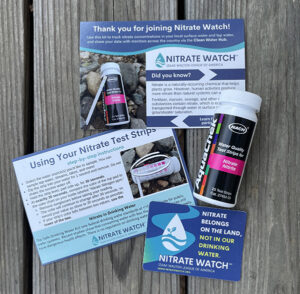 Your kit will include a bottle containing 25 nitrate test strips which you can use to test your water source(s) throughout the year. You’ll also receive postcards explaining how to use your nitrate test strips and how to share your Nitrate Watch results on the Clean Water Hub.
 Your kit will include four test strips so you can test your waterway throughout the season. You’ll also receive a chart to help you interpret your results and a postcard with instructions for completing a Salt Watch test and reporting your findings.