The problem of nitrate pollution in drinking water has swelled to a crisis in parts of the Midwest, California, the Gulf of Mexico and other places where agricultural runoff or…
In this letter to the editor, Terence Turnovsky, President of the Linn County Chapter of the Izaak Walton League of America, expresses concern about the removal of seven stream segments…
The health of our local waterways relies on dedicated individuals who turn their passion into action. Today, we’re excited to shine a spotlight on Lauren Eaton, Monitoring Manager at Friends…
An unnamed tributary of Indian Creek, which feeds into Virginia’s Smith Mountain Lake, has been monitored by Virginia Save Our Streams (VA SOS) volunteers Jean and Lee Borgman for over…
In February 2025, a Salt Watch volunteer visiting a gas station in Leesburg, Virginia stumbled upon a massive oversalting event. Having seen the consequences of such oversalting on waterways firsthand…
Sasha and Aisha, sixth-grade students in the Roberto Clemente Math, Science and Computer Science magnet program, conducted an investigation into how proximity to roadways influences water pollution in local lakes.…
Residents in Central Iowa have been placed under a first-of-its-kind lawn watering ban in response to stress on the water utilities from nitrate pollution in water sources. Data and insight…
Nitrate Watch volunteers have been busy in 2025 and their data is starting to paint a picture. What does the data show us? Nitrate concentrations are steadily climbing in surface…
It’s time to meet another one of our Save Our Streams monitoring volunteers! This time, we’re hearing from Ashley Garrison, a newly certified SOS volunteer in Tennessee. Ashley is a…
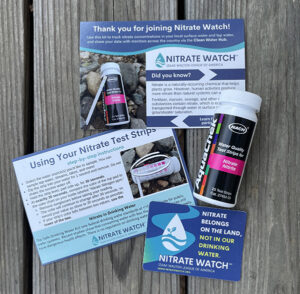 Your kit will include a bottle containing 25 nitrate test strips which you can use to test your water source(s) throughout the year. You’ll also receive postcards explaining how to use your nitrate test strips and how to share your Nitrate Watch results on the Clean Water Hub.
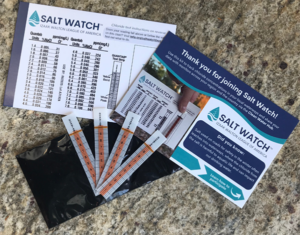 Your kit will include four test strips so you can test your waterway throughout the season. You’ll also receive a chart to help you interpret your results and a postcard with instructions for completing a Salt Watch test and reporting your findings.