Meet a Monitor: Kathy Sykes
Author: Abby Hileman, Salt Watch Coordinator

Community science relies heavily on dedicated local volunteers. For Kathy Sykes, protecting local watersheds blends seamlessly with community connection, education, and a lifelong love for the natural world. Today, she serves as a passionate Stream Leader and advocate in Washington, D.C., proving that retirement is anything but quiet when there is an environment to protect.
Tackling Salt Pollution in D.C. Proper
Kathy lives right in Washington, D.C., near the Maryland border, making the lower Rock Creek watershed her local testing ground. Working alongside her “partner in crime,” Andrea Contreras, and local high school students, Kathy has brought an immense amount of energy to the Izaak Walton League’s Salt Watch program.
Over-salting is a massive structural issue in urban areas, driven heavily by liability fears and a lack of contractor training. Kathy recalls a winter morning near her home where the sidewalks looked like they were covered in a “blue carpet” of salt. When an applicator mentioned they applied it heavily because they were provided the salt for free, Kathy saw an opportunity for education.
Rather than walking past it, she rallied local elected officials from her Advisory Neighborhood Commission (ANC). Together, they swept up and weighed 165 pounds of excess salt from a single stretch of sidewalk. She now uses striking facts like these to anchor monthly public watershed talks with Rock Creek Conservancy at local D.C. libraries from February through June. Her favorite educational tool is a powerful statistic: just a single teaspoon of salt permanently pollutes five gallons of water.
A Lifelong Connection to Science and Nature
Kathy’s appreciation for nature started early. Growing up in Madison, Wisconsin, she was raised by a chemist mother and a politically active gerontologist father. Instead of traditional weekend routines, her family spent Sundays exploring local forests and learning the names of trees.
This early immersion in public service and environmental science paved the way for a distinguished career. Kathy worked on Capitol Hill for a member of Congress, served on a U.S. Senate committee, and worked with the Centers for Disease Control and Prevention’s National Institute for Occupational Safety and Health. She ultimately spent nearly two decades at the Environmental Protection Agency, leading nationwide efforts to build livable, environmentally healthy communities.
When she retired, Kathy didn’t step back from environmental action—she stepped right into her own neighborhood. “My day as a retired woman… is usually something related to gardening, removing invasives, or dealing with protecting the watershed,” Kathy notes. “Every day, it’s the same day. What do we have today?”
She channeled her lifetime of public policy and scientific expertise into grassroots certifications, becoming a Master Gardener, a Master Naturalist, a Weed Warrior, a Pollinator Steward, and a certified Stream Leader with Rock Creek Conservancy, an official Salt Watch partner.
The Cascading Impacts on Water Quality
Through her role as the chair of the Watersheds and Parks committee for her local ANC, Kathy ensures that water quality stays at the forefront of local policy. She drove a strategic neighborhood plan focused on native plants, pet waste outreach, and winter salt pollution.
When a major sewage pipe burst on the Potomac River in early 2026, releasing millions of gallons of raw sewage into the ecosystem, Kathy immediately integrated the disaster into her library presentations. To help residents visualize the scale, she calculated the spill using a timely metric: Olympic-sized swimming pools. By connecting global concepts to hyper-local infrastructure failures, her turnouts spiked as residents sought answers. For Kathy, defending water quality is a moral imperative for future generations.
“The water system is the lifeline for the entire ecosystem—for the forests, for all of the plants and the animals. Why would you do something that you can’t undo that harms the environment? Do you want to just live in a world with cement?”
Kathy Sykes
Finding “Different Doors” for Community Engagement
Kathy believes the key to expanding community science is meeting people “through different doors.” She constantly looks for creative ways to engage different generations. She has hosted native plant walks, organized student volunteers from local high schools, and is currently designing art projects around native pollinators with local Girl Scout troops.
Her organizing brilliance even shines during crises: during previous federal government shutdowns, she recruited furloughed agency workers to join her in Rock Creek Park. Knowing firsthand how frustrating it is to be trapped in the city while furloughed, she gave forest service and public health workers a meaningful way to stay productive by pulling invasive weeds.
When managing cleanups, Kathy keeps volunteers energized by turning data tracking into a game. Volunteers count discarded plastic bottles and highlight unusual finds—including a buried samurai sword discovered during a Connecticut Avenue corridor project!
Kathy’s Advice: Step Up and Join a Team
If you are on the fence about volunteering for a program like Salt Watch, Kathy’s advice is simple: just start.
“There is a very well-developed program backed by incredible research through a wonderful organization that has been around for over 100 years,” Kathy notes. “It doesn’t take a huge time commitment, and yet it makes a huge difference in protecting our watershed for generations to come. If you want to feel like you’re part of a team and making a difference, you’ll feel better getting outside and getting involved.”
Photos by Kathy Sykes.
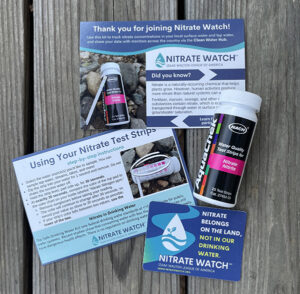 Your kit will include a bottle containing 25 nitrate test strips which you can use to test your water source(s) throughout the year. You’ll also receive postcards explaining how to use your nitrate test strips and how to share your Nitrate Watch results on the Clean Water Hub.
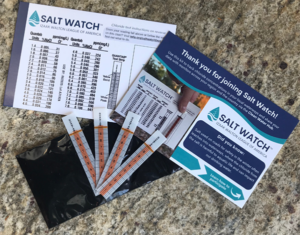 Your kit will include four test strips so you can test your waterway throughout the season. You’ll also receive a chart to help you interpret your results and a postcard with instructions for completing a Salt Watch test and reporting your findings.