Small Actions, Massive Milestones: Celebrating 10,000 Salt Watch Samples
By: Abby Hileman, Salt Watch Coordinator
Can small actions really make a big difference for our waterways? We just proved they can. When I joined the Izaak Walton League back in 2022, the program was already a few years old and hitting impressive strides with over 5,300 samples submitted between July 2022-June 2023. Watching that number almost double has been nothing short of rewarding—but 2025 has completely rewritten the record books.
Fast forward to the 2025 calendar year, and we hit a massive milestone: 10,000 Salt Watch samples submitted to the Clean Water Hub in a single year! It’s a huge win for our rivers and streams, and the momentum is electric. But the season isn’t over yet, and we have more records to break. Will you be part of the next 10,000 submissions? Head to saltwatch.org to claim your free monitoring kit and join the movement.
Story of Our Waterways
The story of our water can be told in as many ways as it takes a raindrop to go along its own journey. Each region has different weather patterns and storm events, and each applicator, county and town may salt differently depending on their expertise.
Road salt is a long-lasting pollutant in the environment, impacting infrastructure, habitats, wildlife, drinking water, pets and more! Just one teaspoon of salt has the potential to permanently pollute 5 gallons of water. There is no feasible way to remove it once salt enters the environment.
- Infrastructure Costs: Road salt is incredibly corrosive and can damage our roadways, bridges, water mains and more. Learn more about Road Salt and Infrastructure.
- Salty Tap Water: Salt isn’t removed by most water utilities because it cannot simply be filtered out! Most water utilities do not have the infrastructure or funding to remove salt from the water. Learn more about Road Salt in Drinking Water and Road Salt, Lead and Drinking Water.
- Ecosystem Degradation: Salt can compact soils, dry out and kill plants and can harm our freshwater aquatic life. Learn more about Road Salt in the Environment.
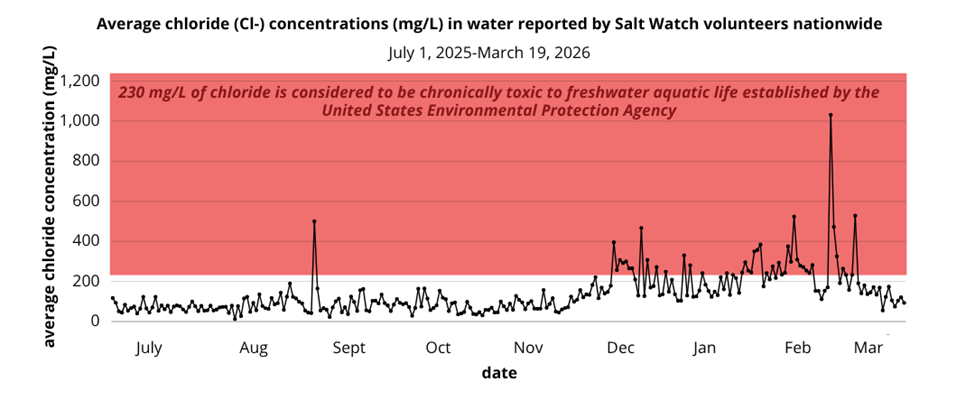
In the Washington, D.C., Maryland and Virginia region (referred to locally as the DMV), the area was hit with a few storms—in early December, a large snowstorm on January 25th (Winter Storm Fern) and a wind storm in mid-March. After the storm in January, the snow and ice stayed around for nearly 10 days due to prolonged sub-freezing temperatures. Because it took so long for the snow and ice to melt, chloride spikes from the road salt pollution runoff weren’t seen in many waterways until substantially later—many seen only in mid-to-late February.
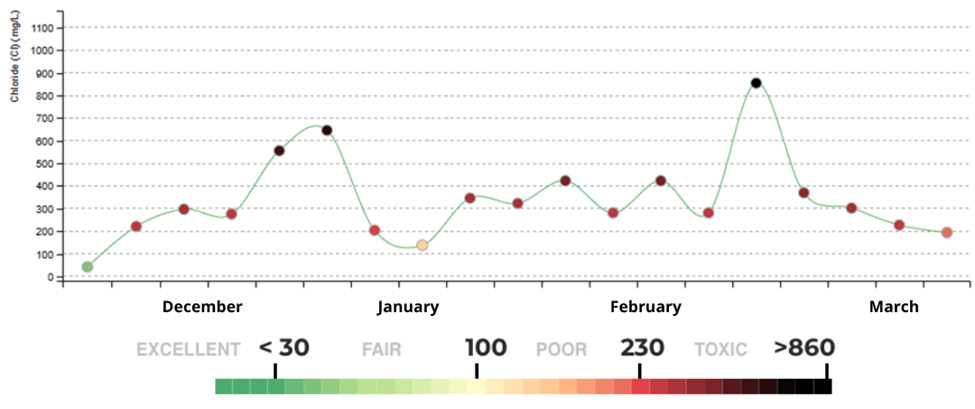
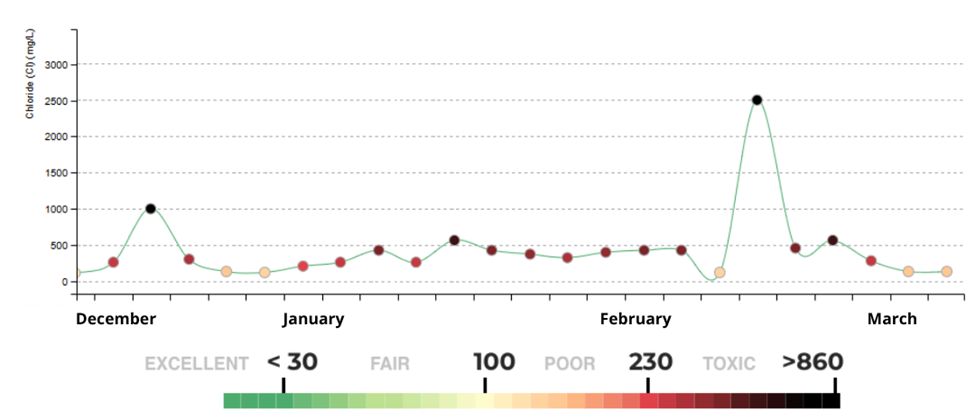
A few different factors could have been at play, causing this delay.
- “Snowcrete”: During the sub-freezing conditions, salt can refreeze and that salt may have been trapped in the immovable snow/ice, known as “snowcrete”.
- Dilution: Once the snow and ice finally melted, the sheer volume of water may have diluted a lot of the salt.
- Salt Retention: It can take a while for salt to flush through the subsurface, as it can be retained by soils before eventually entering the waterway.
Northeast Ohio had early winter events in early November, beginning and mid-December, a New Year’s storm, Winter Storm Fern (January 25) and a late winter storm near the end of February.
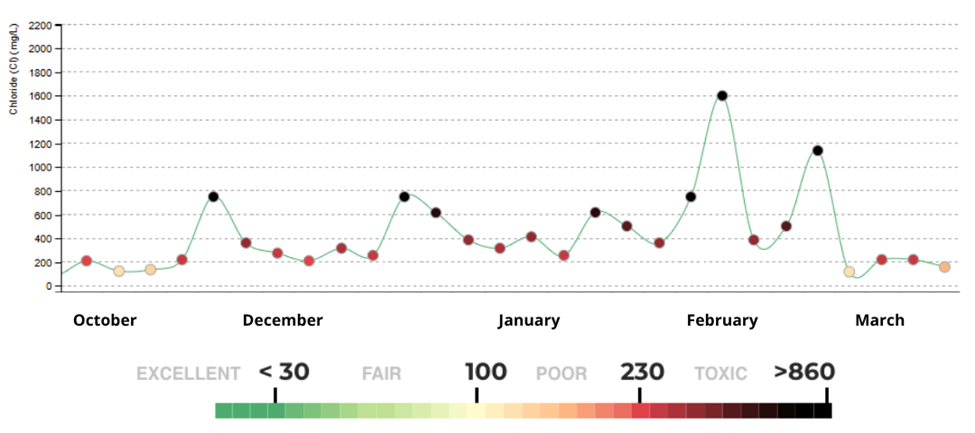
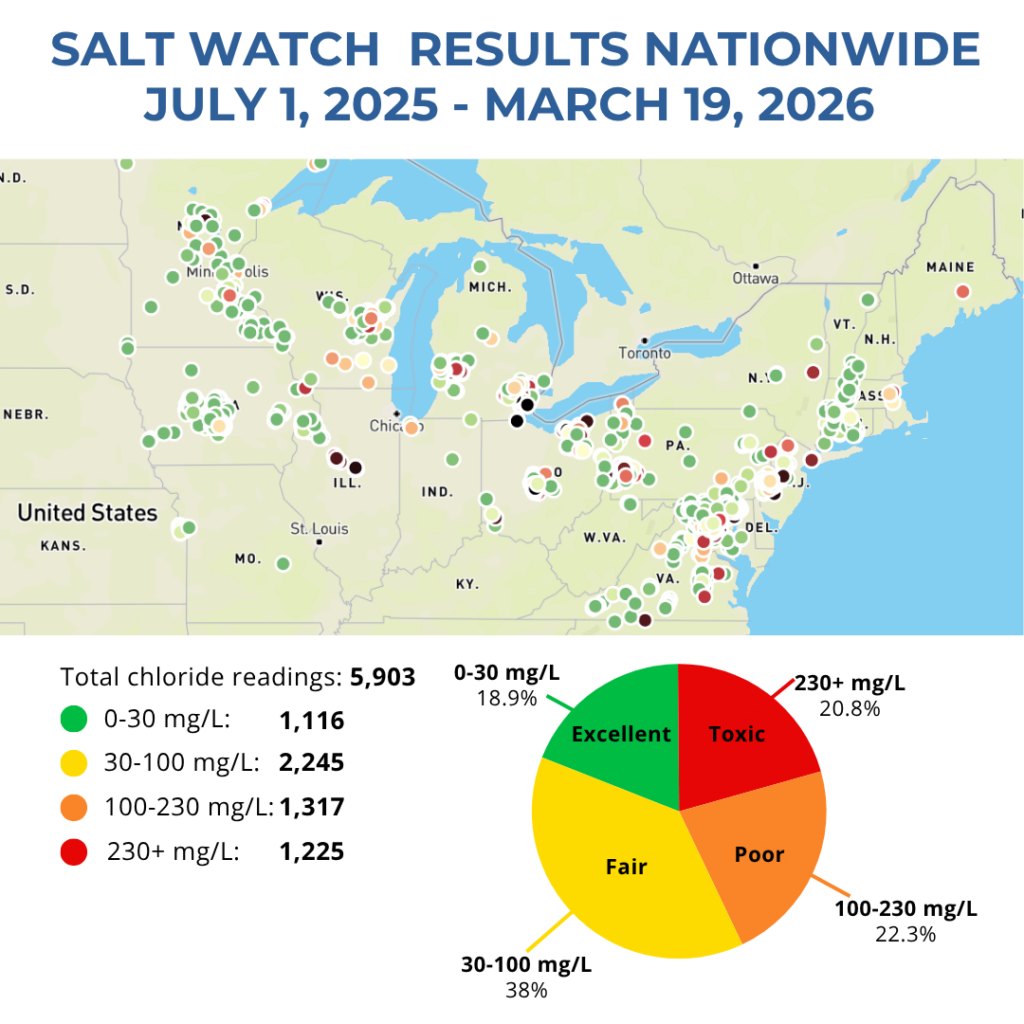
We have received almost 6,000 submissions for the season and are on track for record breaking submission numbers with more elevated and toxic readings than last year’s results.
How You Can Help
- Monitor: Go to www.saltwatch.org to request your free Salt Watch kit to monitor a waterway near you (you can also test your tap water)!
- Spread the word: Many people do not know that salt is a pollutant and we often do not think about where salt goes after it is applied—out of sight and out of mind! Simple things like shoveling, scattering and sweeping can make a huge difference! Shovel early and often to reduce the amount of snow that turns into ice. Scatter salt—a coffee cup full of salt is enough to salt 2 parking spaces, a 20-foot-long driveway or 10 sidewalk squares. Sweep up any excess salt, store it in a closed container and use it during the next storm event!
- Learn more about the issue: Check out www.saltwatch.org and our Advocacy Guide to learn more about the issue of road salt pollution and how you can make a difference.
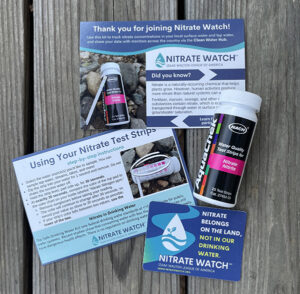 Your kit will include a bottle containing 25 nitrate test strips which you can use to test your water source(s) throughout the year. You’ll also receive postcards explaining how to use your nitrate test strips and how to share your Nitrate Watch results on the Clean Water Hub.
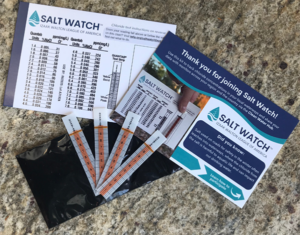 Your kit will include four test strips so you can test your waterway throughout the season. You’ll also receive a chart to help you interpret your results and a postcard with instructions for completing a Salt Watch test and reporting your findings.